Thursday, 21 April 2011

Spring Beneath the Waves, Part 1

(Written for my church's "Spring Miscellany" service.)

“A school of fingerling trout hangs motionless above a meadow of freshwater grass. We could pick them like apples if we cared to. They’re sleeping out the winter, drunk with cold.”

So said the American diver, Andrew Todhunter, diving beneath the surface of a frozen lake in the High Sierras in California in the middle of winter.

I myself, however, have never seen this. Although it is possible to scuba dive in winter in Britain, it requires a warmer diving suit, known as a drysuit, which I have yet to purchase. In addition to this, as Todhunter says, little moves beneath the waves, or beneath the surface of our lakes and quarries, in the depths of winter. The cold-blooded creatures of the water slow down and, like many of their land-based counterparts, hibernate throughout the coldest time of the year.

So, like many British scuba divers, I eagerly await the arrival of spring. There is no official start date to the diving season, since it depends upon local conditions and individual divers’ toleration of different temperatures, but March is usually the earliest many divers will venture back into our seas. Before this, short hours of daylight, rough seas, cold water, and bad weather on the surface make sea diving an unattractive proposition. And, as I’ve said, there is relatively little moving down there to see!

The first dive of the season is always an exciting and slightly anxious time, as we venture back into the habitat we have been away from for so long, and strap ourselves back into our equipment. Though humans evolved to be excellent swimmers on the surface of the water, to return to the world sixty feet below the surface is to venture into an environment we are not naturally adapted to be part of. So, to return to the water we must instead use that great product of evolution, the human brain.

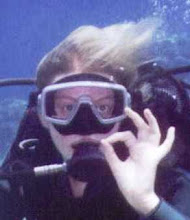
Human ingenuity has designed equipment to compensate for all our physical shortcomings beneath the waves. As I prepare to enter the water, I carry on my back enough air to fill the interior of a large wardrobe at normal atmospheric pressure; compressed to 232 times atmospheric pressure, it fits into a bottle I can carry on my back. A thick wetsuit compensates for our human lack of insulation in the cold water. Lacking flippers or a tail, plastic fins on my feet enable me to propel myself through the water, and a plastic mask holds air in front of my face, so that eyes that evolved to survive on land can see clearly 60 feet beneath the surface of the North Sea.

We climb down across the rocky beach, and cross the rocks to the shoreline with care. Pausing to check that our equipment is working, we fit our masks and fins, put air into our inflatable jackets, and waddle slowly out into the waves. Like seals, divers are not graceful upon the land.

As we enter the water, the cold seeps slowly through our suits. Despite what many people think about diving in Britain, though, it does not stay cold. The thick wetsuits we wear soon trap the water next to our bodies, allowing it to heat to body temperature and keeping the diver warm and comfortable during the dive. People do not believe me when I say that diving in the North Sea does not make you cold, but with the proper gear it’s quite possible to stay comfortable!

Most importantly, as we swim out from the shore to the point at which the water becomes deep enough to submerge, we turn onto our fronts and dip our faces into the water. With our masks on, we can see beneath us into the world we will soon be entering.

The concept of the doorway into another world is a long and ancient one. There can surely be few human cultures that have not developed the concept of human beings being able to pass from the day-to-day world we all inhabit into another world where the normal rules of existence do not apply; whether it be Alice going through the Looking Glass, or the ancient Romans worshipping Janus, god of doorways and gates. Typically, the person going through the doorway must prepare themselves in some way to do so, and, whilst in the other world, may find that they have acquired new abilities, or will face new challenges...

Saturday, 9 April 2011

Overheard in an Italian Restaurant in Newcastle

"Oh yessa, we getta the people in here, sometimes inna fancy dress. Rocky Horror Show, that is notta so good. Too strange. Reminds me of thatta MP, found dead in... mysterious circumstances. Issa how his companion musta been dressed, she look at him, go "Oh dear, he has croaked it. Oh well, onna to next appointment". You cannot getta the hookers these days. Look at Silvio Berlusconi, evenna the prostitutes lie about their age these days, 15-year-olds looka 22! Strange man. Who wants coffee? Dessert?"

Monday, 4 April 2011

Wearing My Dragons, Part 1 (My Chemical Romance)

To wear the dragons, or not to wear the dragons? I pondered the question as I wandered slowly home via Warwick Street.

I have owned my dragon pants for ten years, making them one of the oldest items of clothing I have in my wardrobe. They were purchased from a stall in a mall in Toronto when I went there to visit my cousins on a gap year. (I am somewhat proud that, if anything, they fit better now than when I was 19.) They are somewhat hard to describe, which is why I’m including a photo of them here. They came with a matching top, and ever since then I’ve wished I had bought it, but I hadn’t really got the money even for the dragon pants themselves, so it wasn’t going to happen.

They are probably the most unique item of clothing I own. When I was at Uni I used to hang around with some vaguely Gothy friends, largely because I went to Durham University and after the first week’s shock at being surrounded by posh public school kids wore off, those of us who were in any way “different” swiftly banded together for support. We used to go to Krash rock / alternative club in Newcastle, as it was then, and jump up and down to “Jump Around” whilst swigging vile alcopops. It was the sort of place where people danced so madly you had to wear Doc Martins if you wanted to return with all your toes intact, and I was vaguely unnerved the first time I went in, but the magic dragons worked their spell. Krash had UV lights, and the dragons glow purple underneath it. I would have Goth chicks with layers of make-up that could double as armour and piercings in places I hadn’t known piercings could be (I had a sheltered upbringing) coming up to me and going “Awesome dragons!”.

In short, they are fantastic. However, they can only be worn on days when I’m feeling really confident and kick-ass, since it is impossible to wear them and not be noticed. Did a trip to see My Chemical Romance merit the dragons, I wondered? I wanted to wear them, but I would be going in on the bus… on my own. I knew no-one else who liked My Chemical Romance, and frankly I’d rather not see a band I really love than see them in the company of someone who’s sitting there hoping things will all soon be over. What’s the point? Perhaps I’m over-sensitive to other people’s feelings, but this was my present to myself.

Presented to myself with not a little trepidation, since the last time MCR played at the arena (in 2007) it didn’t go so well, with the crowd not being as enthusiastic as the band would have liked, and Gerard Way screeching at them to get up and jump. I’ll admit, I was somewhat put off by this. On the one hand, I guess that there are few things more frustrating than giving it your all in front of a crowd who can’t be bothered (and if you’re a rock star, bad days at the office happen in front of thousands of people). On the other, there will have been people in that audience for whom that gig will have been a big, big, deal (MCR attract that sort of fan) and who will have been jumping up and down with all their might, and having their favourite band’s frontman cursing them out won’t have been much fun for them. In the end, I decided that I’d kick myself for the rest of the year if I missed the chance to see them live, and I was going to take the chance. If it turned out they were awful, then so be it; I’ve been disappointed before.

In the end, and in a similar vein, I decided it, it, I’m wearing my dragons, ate tea, and caught the bus to Central Station, where I blended in with the stream of people wearing some variation on black. Pleasingly, I was not the only person over the age of 15 there; there were certainly a few teenies, but also quite a few who, like me, fit into the “old enough to know better, young enough not to care” bracket. The steward on the road block shouted “Nice dragons!” at me, and I acknowledged him with a grin. I wandered into the arena and peered in at the stage. Skinny men with guitars were making a racket, but since it was 8pm it was the support act (Blackout) and I wasn’t that bothered (sorry, Blackout fans).

I wandered around the merchandise stalls vaguely wondering whether to buy stuff or get a drink and go inside and have a listen, and contemplated that well-known question: When the hell did my life get so boring? This was the first time in months I’d done something purely for myself, and if you think that makes me sound selfish, then I thought that too – and realised that I don’t care. Why shouldn’t I throw all of my energies into making my own life better? What I’ve been doing so far hasn’t secured me any of the things that I want for my life. I’m nearly 30 and my apologising for myself, thinking of others, trying to be a better, more considerate person, seems to have got me absolutely nowhere. Why shouldn’t I have more fun and do more things based on what’s best for me?

My musings upon the meaning of life were interrupted by a thousand-to-one encounter with a friend, who, like me, had not told anyone where he was. We had the following exchange:

“You told anyone you’re here?”

“Nope. You told anyone you’re here?”

“Are you kidding?”

We drank our pints, swapped tales of graphic novels and gigs, and dislikeable colleagues, and wandered in for just before 9.

Thursday, 31 March 2011

How To Fit A Rear Reflector To A Mudguard


• Highly recommended (by me) since this gives drivers a good idea of where your bike actually is. Reflectors on the saddle post are helpful, but can be a little deceptive at night, since they show where the saddle is, not the rear wheel. Most are sold with the advice that you will need to drill a hole through the mudguard. Do not let this put you off, here’s how to do it even if you are a mechanical idiot (like me).


• You will require a couple of Phillips screwdrivers, one smaller than the other, the rear reflector, a black marker pen, latex gloves if you have them, possibly some Blu-Tack, and a rigid but thin board. This latter can be anything: cardboard, plastic, metal, antyhing so long as it will fit in between the mudguard and the tyre. This, of course, assumes that your mudguards are plastic. If they are metal, you may wish to trot down to your friendly cycle mechanic and smile nicely.


• Mark (with the pen) on the mudgard where you want the reflector to go. Put the board inbetween the tyre and the mudguard.


• Put the point of the small Phillips screwdriver against where you want the reflector to go, press it against the mudguard, and twist until you make a small hole. The board is a vital part of this operation since, to paraphrase the great Terry Pratchett, it takes a great deal of effort to push the screwdriver through the mudguard, and almost none whatsoever to put it all the way through into the tyre, which is a bugger.


• If the hole isn’t big enough, use the large Phillips screwdriver to widen it – insert and twist.


• Fit the screw through the mudguard, and fasten with the nut that came with it. Check as you do this that the screw is not rubbing against the tyre at all. it will weaken the tyre if it does. Hold the bike off the ground, spin the wheel, and listen for any sounds / feel for resistance against the tyre.


• You may find that the screw is slightly too long to put the reflector flat against the mudguard without the screw pressing against the tyre. This is why you have Blu-Tack. If this happens, get the reflector as close to the mudguard as you can without putting the screw against the tyre, then press the Blu-Tack in between the reflector and the mudguard. This is a good idea anyway, as it helps to hold the reflector onto the mudguard. Believe me when I say that whenever you turn the bike round, the rear reflector will get bashed against doors / walls / bike stands / whatever, so it needs to be very firmly fixed on.


• If you’re feeling fancy, colour in the Blu-Tack with the marker pen so that it doesn’t show.


• Done!

Monday, 28 March 2011

Toddlers With iPods: Some Further Thoughts on Cycling

1. Assume that all pedestrians you see have the road sense of toddlers with iPods, particularly if they happen to be students. Most of them aren’t, but this will prepare you to deal with the inevitable one or two who are, and who will step right out into the road without bothering to look. You would think that people who have voluntarily deprived themselves of the sense of hearing would be extra-vigilant when crossing roads, but it doesn’t work like that.


2. Ride assertively, but don’t be an arsehole. Give cars room to pass whenever you can, but only when it’s safe to do so. You have an equal right to be on the road, and you must claim it. If you need to pull out around a car and there’s another car behind you, get in position nice and early. If they have to slow down, they have to slow down. Drivers will deal with this far better than if you suddenly swerve out at the last minute.


3. Never, ever, undertake. Do not go up the left-hand side of a lorry or bus. More cyclists get killed doing this than any other manouevre. They can’t see you and they WILL squash you. Filtering up the left-hand side of a row of stopped cars at a traffic light is a different matter – UNLESS one of them is a lorry or bus!


4. Flashing lights are legal as of 2005. I used to think they weren’t, and rode with steady lights, but not any more. As a driver, I realised that when I saw a flashing white or red light, I immediately thought “bike”. This is the reaction you want. No other road vehicle uses flashing lights, so they immediately identify you as a bicycle, and they are more eye-catching than steady lights. My two cents – choose what suits you.


5. Keep the wheel reflectors on your bike. As a driver, often the only time I’ve seen a bike crossing a junction or road in front of me at night is when the headlights reflect off the distinctive rotating reflectors.

Saturday, 12 March 2011

Stuff Which Is Not Essential, But Which You May Wish To Consider, Part the Last

With a special focus on maintaining the bike, to round things off.

15. Chain cleaner, solvent and sprocket brush

This is edging towards the “bike maintenance” side of things. A chain cleaner is really two things: a set of brushes that clip over the chain, and a concentrated solvent used to make up the solution in the brush holder that dissolves the grease and muck on the chain. You will need to buy this from a bike shop, or you could look online. No particular mechanical skills are required to do this, but it does take a willingness to spent 15-20 minutes cleaning the bike, then cleaning the chain cleaner brushes. A sprocket brush is used at the same time to get the muck and debris off the sprockets and chainwheels at the back of the bike (this is, of course, assuming you’re riding a bike with derailleur gears!). Most serious cyclists will do this at least once a month as cleaning the muck off helps to stop wear and tear on the chain and sprockets, leading to easier gear shifts and making the parts last longer. If you are going to do this, buy yourself some latex gloves! and you may want to think about getting a bike stand (see below).

16. Latex gloves

Usually available for a couple of quid from Wilkinsons / the pound shop, or anywhere that sells motoring supplies. Few things can stick to your fingers quite like the unique mixture of road muck and cycling oil that the bike chain gets covered in. Latex gloves are great for avoiding this. Pop them on before you do any work on the bike, peel them off and bin them at the end, problem solved. (If you do get cycle grease and muck on your fingers, a nail brush and neat washing up liquid is what’s required!).

17. Bike stand

Again, this is for if you’re getting more into cleaning and maintaining your bike. You will probably need to buy it from a bike shop. A bike stand supports the bike, holding the rear wheel off the ground. This allows you to rotate the pedals freely, which is essential if you’re trying to clean the chain – it is well-nigh impossible to hold the bike off the ground with one hand, hold the chain cleaner on with the other, and rotate the pedals! Also essential for if you get into maintaining your bike and need to adjust the gears. About £15-£20.

18. Multitool

Essentially a cycling Swiss Army knife. They often come in “bike repair kits” from Wilkinsons, etc., or you should be able to get them quite easily online or at the bike shop. They usually consist of a set of Allen keys, and a set of screwdriver heads, the idea being that you keep it with you to help make any adjustments / running repairs to the bike as required (they are best kept in your saddlebag, rack pack or panniers). Well worth getting since, even if you don’t plan on doing any bike repairs, someone else might be able to use it. If you do buy one, bear in mind that they can go rusty if they get soaked in the rain, so it may be wise to keep it in a plastic bag (a sandwich bag is about the right size!). And finally...

19. Trouser clips

You may or may not feel you need these. They do have a rather dorky, businessman-on-a-folding-bike type image, and a lot of people never bother with them. Personally, I tend to avoid the need for them by wearing trousers that fit closely and don’t flap about. Since my usual cycling apparel is a pair of El Cheapo trackie bottoms from Primak, I usually adjust them by using safety pins to pin together any loose fabric at the bottom of the trouser legs. I really don’t like my trousers flapping around when I’d riding; it’s distracting, and the worry that they might get stuck in the chain is one more thing on my mind that I can do without. I’m also not a fan of clips, however, since I’ve yet to find any that don’t feel as through they are about to slip down your leg, no matter how firmly you try to clip them on – another distraction I can do without. However, one thing I have found that works well is trouser bands. These are elasticated fluorescent bands that fasten with Velcro around your calves, and they are a lot more secure. You can buy them from Poundland for a quid each, and if you are lucky you can get the extra-dorky but highly visible ones with flashing lights on. I keep a pair in my panniers just in case!

Wednesday, 9 March 2011

Stuff Which Is Not Essential, But Which You May Wish To Consider, Part the Third

Some of you may have noticed a bias towards cycling and away from finishing up the Epic Tale of Glastonbury 2010. The reason is simple. I'm knackered and writing up a list of stuff that you need to go cycling with is way easier than dragging back my memory to June 2010, when the sun shone, life was simple, and I wasn't having to interview for my own job.

The Epic Tale of Glastonbury will be finished, probably some time in April.

Also, some of you who have read Nick's post may wonder what a cyclist in an Ozzie hat looks like. Here's a picture: wonder ye no more! (And yes, that is my bike in the background with the panniers on.)

More stuff to consider buying if you take up cycling:


12. Toe clips

Opinions are mixed. Some people feel they trap your feet on the pedals and prefer to ride without. Some people scorn them and prefer cleats; special pedals with special shoes, where the shoes clip onto the pedals. Personally, I find them the perfect compromise. They are much cheaper than cleats, not difficult to fit even if you are a mechanical incompetent, and mean that you don’t have to have two pairs of shoes: one with cleats for the bike, one without cleats for the rest of your day. They greatly improve your pedalling efficiency by holding your feet in the ideal position on the pedal, and meaning that your feet can’t slip off. There is a certain technique to getting your feet in both clips when starting off, but it takes around half an hour to master, and with practice you can do it with no thought. As for the trapping your feet thing, it’s not really an issue – pull your foot firmly backwards and it will come out of the clip!


13. Cycling glasses

Essentially wraparound shades that cover the whole of your eyes, including the sides. These are mainly handy for people who don’t wear glasses, as they keep wind / rain / flies out of your eyes, but people who do wear glasses may also find them handy! I have two pairs; a tinted pair for daytime, a clear pair for nighttime. Again, you can buy them cheaply on Ebay.


14. Water bottle

Available dead cheaply from anywhere that sells cycling supplies, but not often actually sold with the bike. Most bikes have a place on the frame – usually on the bottom tube – with holes where you can screw the water bottle holder onto the bike. Remember to remove it if you lock the bike up outside! Change the water in it frequently.